August 10, 2026

Accounting firms will need to address an increase in clients with limited resources while continuing to deliver high-quality service and meet deadline commitments, all with carving out time to focus on higher-value client advisory. Growing the business internally simply won’t achieve this at the speed required.
This is where white label accounting services can offer a scalable alternative. An external accounting team works behind the scenes while the accounting firm continues to own the client relationship and deliver the service under its own brand.
For firms serving clients across the USA, UK, Australia, and other international markets, this model can provide additional accounting capacity without requiring every increase in workload to result in another internal hire.
What is white label accounting? It is a service model where an external accounting team completes agreed accounting work for an accounting firm, while the final service is delivered to the firm's clients under its own brand.
Your firm will be externally client-facing and will manage communication, relationships, and the end-product deliverable. The outsourced team will be a background component operating under your firm’s processes, standards, and requirements.
This is what makes white label accounting different from conventional outsourcing. The objective is not simply to transfer accounting tasks to another company. It is to create an extension of the firm's delivery team while keeping its brand at the center.
For instance, if a CPA firm agrees to handle extra bookkeeping, accounting reporting, or tax work but doesn’t have staff availability in place, instead of hiring an additional employee, it can outsource the work and have it completed by a white label firm behind the scenes; the accounting client won’t notice any changes.
The client will assume the outsourced accounting firm is additional staff from the accounting firm it contracted with.
Understanding how white label accounting solution works becomes easier when the model is viewed as an extension of an existing accounting practice.
The provider first learns about the firm's clients, services, software, workflows, and expectations. This helps the team understand the firm's operating model and the specific requirements it needs to meet.
The firm's accounting processes, reporting formats, quality standards, and technology environment are reviewed so the external team can fit into the existing workflow. This creates a clear understanding of how work should be handled, reviewed and delivered.
Accounting professionals with the appropriate skills and market knowledge are assigned to the engagement. PCS Global, for example, provides dedicated teams based on client and regional requirements, helping firms work with professionals suited to their specific needs.
Before live work begins, the team is briefed on client requirements, processes, formats, and expectations. This knowledge transfer helps establish consistency from the start and ensures the team understands the firm's preferred way of working.
The team manages the agreed accounting activities while keeping the accounting firm updated through ongoing communication and reporting. Regular reporting provides visibility into progress, while continued coordination helps address changing requirements and maintain delivery standards.
PCS Global follows a five-step process covering introduction, process assessment, team allocation, knowledge delivery, and ongoing delivery and reporting.
The goal is simple: the external team should fit into the firm's workflow rather than create another workflow to manage.
The scope of services offered by White Label Accounting Firms depends on the provider and the accounting firm's specific requirements. Common white label services include:
Client accounting services (CAS) are most beneficial to firms looking to manage accounts on an ongoing basis as opposed to annual compliance engagements. PCS Global’s white label offering covers aspects like day-to-day finances, cloud accounting, and continuing accounting operations.
White label accounting firms can help accounting practices expand their service capabilities without significantly increasing their in-house workload. By partnering with an experienced white label provider, firms can improve efficiency, manage more clients, and focus on long-term business growth.
Expand Delivery Capacity: A dedicated external team gives accounting firms additional capacity without requiring every increase in demand to result in another permanent hire. This allows internal teams to manage their core responsibilities while additional work is handled efficiently.
Serve More Clients: Additional delivery resources can help firms accept new clients and manage larger portfolios without putting excessive pressure on existing teams. This creates room for growth while helping maintain consistent service quality.
Create More Advisory Capacity: When routine accounting work is handled efficiently, experienced professionals can spend more time on client relationships, review, financial analysis and advisory services. This allows firms to focus their expertise on work that creates greater value for clients.
Access Specialist Expertise: A white label provider can bring access to professionals experienced across different accounting environments. PCS Global's teams work across US, UK and Australian accounting standards, helping firms support clients across multiple markets.
Manage Seasonal Workloads: Tax seasons, year-end deadlines and periods of rapid client growth can create temporary workload spikes. A scalable support model gives firms additional capacity when they need it, without requiring permanent changes to their internal structure.
Maintain Your Brand: The external team remains behind the scenes while the accounting firm retains the client relationship and brand experience. Clients continue to engage with the firm they know, while the additional delivery capacity works seamlessly in the background.
The decision usually comes down to three things: capacity, scalability, and focus.
To combat client capacity constraints without internal resources, “New clients can, for a while, push capacity before we need to hire, but now hiring involves infrastructure, onboarding, training, and continued people management resources."
White-label accounting: ‘the best of both worlds.’ In this scenario, the established accounting firm manages the client and advisory roles and outsources a portion of production to a specialized outsourced team. This frees up the established firm’s people.
White label accounting can be particularly relevant for:
PCS Global specifically supports CPA firms, UK accounting practices, bookkeeping businesses, tax preparation firms, Australian BAS and accounting firms, and virtual CFO firms.
Learn More: Why CPA & Accounting Firms Choose White Label Accounting in 2026
White label accounting can provide additional capacity, but the provider and operating model need to be selected carefully.
Establish clear communication channels, responsibilities and reporting schedules from the beginning. Regular communication keeps both teams aligned on priorities, deadlines and client requirements while making it easier to address issues promptly.
Define review procedures, documentation standards and quality expectations before live delivery begins. A clear quality framework helps maintain consistent work and ensures deliverables meet the firm's established standards.
Evaluate how client information is protected, including security infrastructure, access controls and confidentiality practices. Financial data requires strong safeguards, so security measures should be assessed before any client information is shared.
PCS Global highlights ISO 27001 and ISO 9001 certifications, GDPR compliance and secure infrastructure as part of its white-label accounting offering.
A structured knowledge-transfer process helps the external team understand the firm's preferred workflows. Clear documentation and process training make it easier for the team to integrate with existing operations.
Choose a provider that can adjust resources as client volumes and requirements change. Flexible capacity helps firms manage seasonal peaks, new client additions and changing workloads without disrupting delivery.
The objective should be to create one coordinated accounting function, not two disconnected teams.
There is no universal answer. The right approach depends on the firm's size, workload, growth plans, and operating model.
| Factor | White Label Accounting | In-House Hiring |
|---|---|---|
| Capacity | Scales with workload | Linked to headcount |
| Recruitment | Managed by provider | Managed by the firm |
| Training | Provider-led | Firm-led |
| Flexibility | Resources can adjust | Changes generally take longer |
| Client relationship | Retained by the firm | Directly internal |
| Best suited for | Flexible delivery capacity | Permanent internal capability |
For many practices, the choice does not have to be entirely one or the other. A hybrid model can keep senior and client-facing professionals in-house while a dedicated external team supports recurring accounting work.
Learn More: White Label vs Outsourced Accounting: Which Is Best for CPA firms?
Price should not be the only consideration when selecting a provider. The right partner should also bring the expertise, security, scalability, and processes needed to support your firm's long-term goals. Evaluating these factors together can help you choose a provider that delivers value beyond cost.
Does the team understand your market, accounting requirements, and client industries? Relevant expertise helps the team work with greater context and adapt to the specific expectations of your firm's clients.
Will you have a consistent team that learns your processes, or will work move between different resources? A stable team can build familiarity with your workflows and deliver more consistent support over time.
Understand how client data is protected and what certifications, confidentiality measures, and security practices are in place. Strong safeguards are essential when your provider will be handling sensitive financial and client information.
A structured process for assessment, team allocation, and knowledge transfer can make integration smoother. It also gives the external team a clear understanding of your firm's processes and expectations before delivery begins.
The provider should be comfortable working with the platforms already used by your firm. PCS Global supports platforms including QuickBooks, Xero, Sage, NetSuite, Zoho Books, FreshBooks, and MYOB. Technology compatibility helps the team integrate into existing workflows with minimal disruption.
Ask how easily resources can be increased when your client base grows or workload peaks. The ability to scale support when needed can help your firm respond to growth without creating unnecessary pressure on the internal team.
Turnaround, quality, communication, expertise, security, and the management effort required from your team all contribute to the real value of a white label arrangement. A provider that performs well across these areas can offer stronger long-term value than one selected on price alone.
The right provider should make your practice easier to scale, not harder to manage.
Learn More: How to Choose the Right Outsourced Accounting Firm for Your Business
PCS Global's white label accounting model is designed to work as an extension of an accounting firm's existing team.
PCS Global provides dedicated accounting teams who become familiar with your firm's processes, clients, and expectations, helping maintain consistent delivery over time. Its multi-market expertise supports accounting firms across the USA, UK, and Australia, with a wider international presence including Ireland, New Zealand, Europe, and India. This allows firms to work with a team that understands the requirements of different accounting environments and client markets.
The flexible engagement models allow firms to choose the level of support they need, whether for a specific service, selected clients, or broader accounting operations. Resources can also be adjusted as workloads change. Alongside this, PCS Global offers technology-enabled delivery, with teams working across widely used accounting platforms and fitting into the technology environment already established by the firm. This helps maintain smoother workflows without requiring unnecessary changes to existing systems.
When accounting work is handled externally, security and confidentiality remain essential. PCS Global highlights ISO 27001 and ISO 9001 certifications, GDPR compliance, secure infrastructure, and NDA-based data protection practices to support the handling of sensitive financial information. Its broad accounting capabilities cover bookkeeping, accounts payable and receivable, payroll, taxation, financial reporting, and client accounting services, giving firms the flexibility to build additional delivery capacity around their specific requirements.
Most importantly, the model keeps the accounting firm at the front of the client relationship while PCS Global works behind the scenes as an extension of the delivery team.
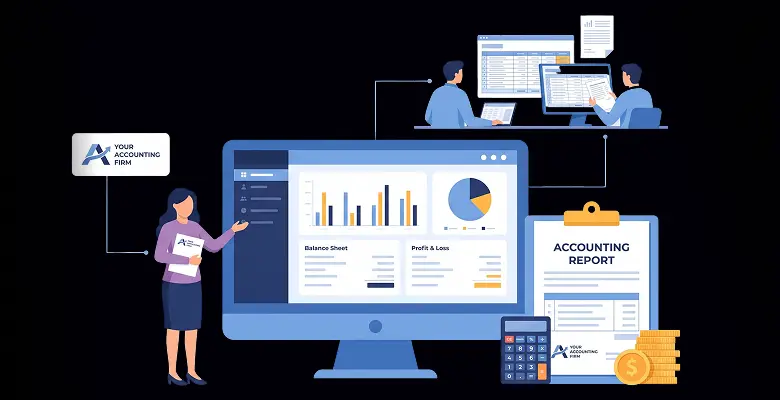
White label accounting solutions give accounting firms a practical way to expand their delivery capacity while keeping their brand, client relationships, and professional identity at the forefront.
It supports a firm in managing fluctuating volumes of business, responds to seasonal fluctuations, builds up a practice's ability to take on new clients, and provides more time to carry out client advisory and other important tasks.
Yet ultimately, what lies behind a successful white-label solution are numerous variables related to the accountancy outsourcing specialist. These include communication, accounting skills, technical capacity, processes, data security, and scalability.
For firms across the USA, UK, Australia, and other international markets, PCS Global provides dedicated white-label accounting support designed to work as an extension of the firm's existing team.
The right white label model doesn't replace your accounting firm. It gives your firm more capacity to grow.

September 23, 2026

September 10, 2026